Malaggar is a free lore resource for anyone creating a Pathfinder campaign. It offers an established setting you can explore and use as the foundation for your own adventures, campaigns and modules.
Begin with XB1287, the star system created by Malaggar. Discover its gods and worlds, then journey to Saimar: a planet of dragonlands, ancient magic and 128 umbras on the continent of Umbraal.
XB1287, also called Xeno-Balance, lies approximately 12 million light-years from Golarion. It was the first successful result of Malaggar’s 1,287 attempts to create a balanced system with two suns.
Malaggar created XB1287 as an experiment with his divine powers. It was his first success in 1,287 attempts to create a perfectly balanced solar system with two suns. In each of the previous 1,286 attempts, the stars collided, creating a neutron star or a black hole.
He eventually realized that love was necessary to maintain the balance between the stars, keeping them in harmonious orbits and preventing another collision. To achieve this, he split himself to create Alfari and Dalnos, then placed them within the stars.
As a sign of his appreciation, Malaggar granted Alfari and Dalnos one day together on Saimar every 1,000 years. There, they could experience life together as mortals would: the ultimate gift for two gods in love.
At the center of XB1287, two white dwarf stars orbit one another. They bear the names of the Saimarian deities who dwell within them: Alfari, goddess of war, and Dalnos, god of love.
Dalnos shines a brilliant white, representing the purity of love and the very essence of the god himself.
Once every 1,000 years, Alfari and Dalnos appear on Saimar for a single day. They always appear in the same place, and people gather from across the world to witness their reunion.
The two spend the entire day together in public, embracing one another, blessing their followers and sharing their wisdom. They gladly speak with those who gather, offering insight into love, war and the balance of the world.
Alfari and Dalnos have turned their backs on Lihiri and do not acknowledge it as a habitable world.
Nine deities shape XB1287. Malaggar stands above the others as the arbiter of balance, uniting their often conflicting natures. Each deity represents a part of his cosmic experiment.
Malaggar is the central figure in the pantheon, the ultimate arbiter of balance in the cosmos. He embodies the tension between light and dark, life and death, and creation and destruction. As the creator of XB1287, he oversees its stability, ensuring no force—divine or mortal—tips the scales too far.
Domains
Darkness, Time, Balance
Alignment
Neutral
Favored weapon
Kusarigama
Appearance
A towering figure clad in shimmering black armor, wreathed in an aura of dim starlight. His eyes glow faintly silver, symbolizing his mastery over time and shadow.
Sacred symbols
A black sun with a silver crescent moon orbiting it; an hourglass with sand made of starlight.
Followers
Judges, scholars, and those who seek balance in chaotic situations. His worshipers are often called Arbiters and act as impartial mediators. They aim to restore order in times of crisis, whether through diplomacy or decisive intervention.
Temples & rites
Built in symmetrical designs, often constructed from black marble and silver-veined stone.
Central features include hourglass-shaped altars and reflecting pools illuminated by dim, magical starlight.
Anathema
Create chaos or imbalance intentionally.
Exploit others through manipulation without seeking a greater purpose.
Destroy records, knowledge, or artifacts essential to preserving history or time.
Divine gifts
Malaggar grants his clerics and champions abilities tied to controlling light and shadow. They can manipulate time on a small scale (for example, hastening allies or slowing enemies).
Mortal influence
Malaggar is revered as the final authority in disputes, and his word carries weight even among rival factions. His clerics are often consulted as arbitrators.
Weapon symbolism
A dual weapon of chain and blade, embodying balance, versatility, and the passage of time. One end reaps life, the other restrains — perfect for the Arbiter.
The Shadow Texts
The faithful preserve Malaggar’s teachings, rites, and prayers in the sacred book known as The Shadow Texts.
Shelreya represents leadership and the unity of opposites. As a mortal, she safeguarded her people with both compassion and an unyielding will, and as a goddess, she serves as a protector of those seeking harmony between light and darkness. She is revered by rulers, mages, and defenders alike.
Domains
Leadership, Magic, Protection
Alignment
Neutral Good
Favored weapon
Bo staff
Appearance
A radiant figure cloaked in cascading shadows shot through with streaks of golden light. Her staff, tipped with a shard of starlight, pulses with divine energy.
Sacred symbols
A staff entwined with shadows and light; an open hand surrounded by a halo of starlight.
Followers
Soldiers, rulers, and mages who strive to protect their people and lead with compassion. Her faithful are called the Guardians of Twilight, a reference to her dual nature.
Temples & rites
Her temples double as fortresses, built with high walls and soaring towers. A central chamber features a golden statue of Shelreya entwined with dark tendrils.
Rituals often involve casting light and shadow magic to symbolize balance.
Anathema
Abuse positions of power for personal gain.
Refuse aid to those who need protection.
Allow injustice or corruption to flourish unchallenged.
Divine gifts
Her followers gain protective auras, bonus spells tied to shielding and leadership, and the ability to call forth radiant and shadowy manifestations.
Mortal influence
Shelreya’s name is invoked by those in positions of power. Her doctrine emphasizes that leadership is both a privilege and a burden, and leaders must always act with humility and resolve.
Weapon symbolism
Symbol of unity and focus. Serves equally as a conduit for magic and a weapon of defense, mirroring her harmony between light and dark.
Venilith governs hidden truths and the pursuit of ambition at any cost. They thrive on subterfuge, inspiring mortals to seek forbidden knowledge or manipulate events in their favor. Venilith is both an ally and a threat to the pantheon, as their schemes often test the balance Malaggar enforces.
Domains
Deception, Ambition, Knowledge
Alignment
Chaotic Neutral
Favored weapon
Dagger
Appearance
A robed, faceless figure whose form shifts constantly between male and female. They carry a mirrored mask and a book filled with unknowable truths.
Sacred symbols
A mirror fractured into dozens of shifting images; a closed book bound with chains.
Followers
Spies, thieves, and seekers of forbidden knowledge. Known as the Shrouded, these followers operate in the shadows, pursuing their goals through deception and cunning.
Temples & rites
Hidden shrines located in caves, ruins, or behind secret doors in cities. A mirror often serves as the central focus, reflecting distorted images of those who look into it.
Rituals include whispered prayers and offerings of secrets written on paper and burned in silver flames.
Anathema
Reveal secrets or betray confidences without sufficient cause.
Act without ambition or purpose, succumbing to complacency.
Refuse an opportunity to learn hidden truths.
Divine gifts
Followers gain bonuses to stealth, deception, and uncovering hidden truths. They can cast divination spells and obscure their presence with magical illusions.
Mortal influence
Venilith’s faithful operate as clandestine agents, influencing politics, trade, and power struggles from the shadows. They rarely act openly, preferring subtlety and manipulation.
Weapon symbolism
Subtle and concealable, the dagger represents secrecy, betrayal, and the pursuit of hidden knowledge — the tools of a manipulator and truth-seeker alike.
Kaelir embodies the duality of creation and destruction, representing the volatile forces that shaped the cosmos. Worshiped by inventors and warriors alike, Kaelir’s domain celebrates the beauty of both triumph and failure, pushing mortals to experiment and grow through trial and error.
Domains
Creation, Destruction, Chaos
Alignment
Chaotic Neutral
Favored weapon
Maul
Appearance
A blacksmith with molten veins visible beneath their partly translucent skin, wielding a hammer that creates or shatters with equal ease.
Sacred symbols
A shattered anvil surrounded by embers; a spiral galaxy forming from debris.
Followers
Inventors, smiths, and warriors who embrace change and destruction as opportunities for growth. Known as the Forged, they see failure as an essential part of progress.
Temples & rites
Found near volcanoes, forges, or areas of significant geological activity. These structures are often half-constructed or deliberately left incomplete to symbolize perpetual progress.
Worship involves forging tools, crafting weapons, or destroying outdated creations in ceremonial flames.
Anathema
Resist necessary change or cling to outdated ways out of fear.
Destroy without intent to rebuild or create anew.
Disparage or stifle creativity in others.
Divine gifts
Kaelir’s followers gain abilities tied to crafting, fire magic, and destructive power. They can summon weapons or armor from divine embers.
Mortal influence
Kaelir’s doctrine encourages mortals to embrace risk and pursue bold ideas, leading to rapid technological and magical advancements. However, these come with inherent dangers.
Weapon symbolism
A weapon of raw force and transformation — the same hammer that forges masterpieces can also bring them to ruin. The maul is the forge-god’s heartbeat.
Thaloran is the guardian of death and the ultimate judge of mortal souls. Though feared by many, he is not cruel; he ensures the cycle of life and death proceeds without interruption. Thaloran’s presence balances Shelreya’s protection of life, creating an eternal dialogue between their domains.
Domains
Death, Transition, Judgment
Alignment
Lawful Neutral
Favored weapon
Scythe
Appearance
A skeletal figure cloaked in flowing robes of deep indigo, carrying a staff adorned with a lantern that illuminates the path to the afterlife.
Sacred symbols
A lantern with an eternal flame; a key crossed with a scythe.
Followers
Morticians, judges, and those who work to uphold justice and honor the dead. Known as the Veilbearers, they ensure souls pass peacefully into the afterlife.
Temples & rites
Quiet, solemn places often located near cemeteries or sites of great tragedies. The temples feature lanterns that burn with an eternal blue flame.
Rituals include guiding spirits, performing last rites, and judging the worthiness of souls through sacred ceremonies.
Anathema
Prevent the natural passage of souls to the afterlife.
Desecrate graves or disturb the honored dead without proper cause.
Judge unfairly or let bias corrupt a decision.
Divine gifts
Followers gain the ability to sense undead, banish spirits, and ease the passage of souls. Thaloran’s champions can channel necrotic energy for healing or destruction.
Mortal influence
His clergy serve as mediators during times of mourning and judges in mortal conflicts, embodying impartiality and compassion.
Weapon symbolism
The scythe’s curved blade echoes the sweeping passage of souls and the inevitability of death’s harvest. A sacred symbol of judgment and transition.
Alfari embodies the fury and intensity of war. She represents the chaos of battle but also the raw passion that drives mortals to fight for what they love. Despite her destructive tendencies, her domain isn’t inherently evil; she honors warriors who fight with conviction, regardless of the cause.
Domains
War, Blood, Passion
Alignment
Chaotic Neutral
Favored weapon
Greatsword
Appearance
A fierce, armored woman with long, crimson hair that seems to flow like liquid fire. Her greatsword glows with an inner light, pulsing to the rhythm of her rage and passion.
Sacred symbols
A blood-red sword with a blazing sunburst behind it; a crimson flame surrounded by a ring of broken blades.
Followers
Warriors, rebels, and lovers of chaos. Known as the Bloodbound, they revel in passion and battle, seeking glory through conflict.
Temples & rites
Open arenas or coliseums where combatants can duel in Alfari’s honor. A brazier burning with crimson flames marks her presence.
Rituals involve blood sacrifices (symbolic or literal) and oaths sworn before battle.
Anathema
Flee from battle without cause or betray an ally in combat.
Suppress passion, whether in love, war, or art.
Fight without conviction or purpose.
Divine gifts
Alfari’s followers gain enhanced combat abilities fueled by rage or passion. They can inspire allies in battle with frenzied cries.
Mortal influence
Her doctrine glorifies combat and passion, inspiring warriors to fight fiercely and live fully. She is often worshiped in times of war or personal strife.
Divine relationships
Alfari shares a passionate but occasionally volatile relationship with Dalnos, reflecting the balance of love and war.
She respects Kaelir’s destructive tendencies and often clashes with Thaloran, seeing death as the end of her purpose.
Weapon symbolism
A weapon of pure might and emotion. Its sweeping strikes and crimson edge embody the tempestuous blend of fury, love, and battle that defines her.
Dalnos is the god of love and unity, counterbalancing Alfari’s chaos with his steadfast devotion to harmony. He represents selflessness and the healing power of connection. His followers are often mediators, healers, and champions of compassion, spreading his ideals across XB1287.
Domains
Love, Unity, Healing
Alignment
Neutral Good
Favored weapon
Morningstar
Appearance
A serene, golden-skinned man clad in radiant white robes, with glowing eyes and a wreath of starlight around his head. His hands radiate warmth and compassion.
Sacred symbols
A golden heart encircled by an unbroken chain; a radiant starburst above clasped hands.
Followers
Healers, diplomats, and romantics who strive to create unity. Known as the Hearthbound, they promote peace and compassion.
Temples & rites
Built near natural springs or in serene groves. Central altars often feature flowing water or radiant crystal sculptures.
Rituals include blessings of unions, community gatherings, and healing ceremonies.
Anathema
Sow discord or hatred among allies or communities.
Allow love or unity to be destroyed without attempting reconciliation.
Refuse to aid the injured or suffering out of selfishness.
Divine gifts
Dalnos’s followers gain bonuses to healing, persuasion, and protection. They can mend wounds and calm tempers with divine energy.
Mortal influence
His teachings inspire communities to work together and build mutual understanding. His priests often mediate disputes and organize charitable efforts.
Divine relationships
Deeply devoted to Alfari, acting as a calming force to her tempestuous nature.
Often works alongside Shelreya, aiding in her protection of the innocent and her efforts to unite others.
Weapon symbolism
Radiant yet firm — a symbol of light’s gentle strength. Represents love’s power to both heal and protect through compassionate force.
Zelyth governs the movements of the stars and the threads of prophecy. They are both revered and feared, for their revelations are immutable, and their warnings often bring isolation to those who heed them. Zelyth is sought by seers, astronomers, and those who wish to uncover their destinies.
Domains
Prophecy, Stars, Isolation
Alignment
Lawful Neutral
Favored weapon
Starknife
Appearance
A cloaked figure with a face hidden in a swirling constellation, their form ethereal and dotted with glowing stars. They hold an astrolabe in one hand and a scroll in the other.
Sacred symbols
A celestial sphere surrounded by an open scroll; a single star suspended in a crescent moon.
Followers
Prophets, astronomers, and those who seek guidance from the stars. Known as the Starseekers, they view destiny as sacred.
Temples & rites
Observatories and mountaintop shrines, often adorned with celestial maps and telescopes. Star charts decorate the floors and ceilings.
Rituals involve stargazing, meditation, and the reading of celestial omens.
Anathema
Alter or falsify prophecies for personal gain.
Act in defiance of celestial patterns or omens without dire need.
Ignore opportunities to share or consult celestial wisdom.
Divine gifts
Zelyth’s followers gain divination spells and enhanced perception. They can read the stars to uncover hidden truths or predict the future.
Mortal influence
Zelyth’s prophets are sought for their wisdom, though their cryptic messages often leave mortals uneasy.
Divine relationships
Zelyth’s prophecies often frustrate Venilith, whose schemes are disrupted by the foreseen.
Respected by Malaggar for their meticulous adherence to balance and cosmic order.
Weapon symbolism
Celestial and precise, the returning starknife mirrors the inevitability of fate and the cycles of the cosmos, fitting for the prophet of the stars.
Vaerix represents insatiable hunger, not just for sustenance but for power, influence, and control. They thrive on mortal fear and desperation, pushing creatures to take reckless actions to sate their desires. Vaerix is worshiped by tyrants, gluttons, and those consumed by greed.
Domains
Hunger, Ambition, Fear
Alignment
Chaotic Evil
Favored weapon
Flail
Appearance
A towering, skeletal figure with an empty void where their face should be. Their ribcage seems to contain an endless, swirling darkness. Their voice is a low, echoing growl.
Sacred symbols
A gaping black maw surrounded by jagged teeth; a skeletal hand gripping a crumbling crown.
Followers
Tyrants, gluttons, and those consumed by greed. Known as the Devourers, they embrace their primal desires and ambitions.
Temples & rites
Hidden in ruins, deep forests, or desolate wastelands. Their altars often feature grotesque carvings and piles of offerings left by desperate worshipers. Rituals involve consuming lavish feasts or destroying symbols of restraint.
Anathema
Deny your desires or suppress ambition due to fear.
Hoard resources without consuming or utilizing them.
Allow fear or hunger to control you rather than empower you.
Divine gifts
Vaerix’s followers gain powers tied to fear and domination. They can inspire dread in enemies and amplify their own strength by feeding on others’ fear.
Mortal influence
Their teachings encourage mortals to indulge their darkest desires, often leading to chaos and societal collapse.
Divine relationships
Loathed by Shelreya and Dalnos for spreading despair and suffering.
Frequently manipulated by Venilith, whose schemes often exploit Vaerix’s primal nature.
Weapon symbolism
Wild, crushing, and relentless — a weapon that embodies insatiable hunger and the chaotic, consuming void at Vaerix’s core.
The pantheon’s relationships bind opposing forces into a larger equilibrium. Malaggar oversees their competing influences to preserve the harmony of XB1287.
Love and warAlfari & Dalnos
Alfari and Dalnos embody a duality that shapes the emotional and physical forces of the universe, driving mortals and gods alike. Their love can be volatile, but Dalnos remains deeply devoted to Alfari and tempers her fury with harmony.
Balance and chaosMalaggar & Vaerix
Malaggar works to contain Vaerix’s destructive hunger. Their opposition reflects the enduring struggle to preserve equilibrium against insatiable desire.
Knowledge and prophecyVenilith & Zelyth
Zelyth’s foresight reveals what is to come, while Venilith seeks to subvert or obscure those truths. Prophecy repeatedly disrupts Venilith’s schemes.
Life and deathShelreya & Thaloran
As siblings in the divine order, Shelreya and Thaloran balance life and death, protection and finality. Shelreya guards life while Thaloran ensures a just end. Their mutual respect keeps their differences from disrupting the natural cycle of existence.
Creation and ambitionKaelir & Venilith
Kaelir’s raw creativity often clashes with Venilith’s careful scheming. The tension between them also drives mortal innovation and ambition.
A volcanic world with a molten surface and unstable ore deposits.
Catalogue category
Rocky planets
Classification
Uninhabited
Desert planet with endless dunes and ancient ruins.
Catalogue category
Rocky planets
Classification
Uninhabited
Metal-rich world, mined heavily for its valuable resources.
Catalogue category
Rocky planets
Classification
Uninhabited
Covered in jagged obsidian peaks, prone to violent tectonic shifts.
Catalogue category
Rocky planets
Classification
Uninhabited
A barren world dotted with meteorite craters.
Catalogue category
Rocky planets
Classification
Uninhabited
A twilight planet that always faces one sun, with lush forests along its dark edge.
Catalogue category
Rocky planets
Classification
Uninhabited
Rugged mountains dominate this gemstone-rich world.
Catalogue category
Rocky planets
Classification
Uninhabited
A dry planet with red soil and expansive canyons.
Catalogue category
Rocky planets
Classification
Uninhabited
A gray, fog-shrouded world with mysterious ruins.
Catalogue category
Rocky planets
Classification
Uninhabited
Cracked by intense quakes; glowing fissures release geothermal heat.
Catalogue category
Rocky planets
Classification
Uninhabited
Arid and cold; known for spire-like rock formations.
Catalogue category
Rocky planets
Classification
Uninhabited
Dominated by a massive, active volcano visible from orbit.
Catalogue category
Rocky planets
Classification
Uninhabited
A vast tundra world with sporadic hot springs.
Catalogue category
Rocky planets
Classification
Uninhabited
Scarred by asteroid impacts; a major resource hub.
Catalogue category
Rocky planets
Classification
Uninhabited
Lush jungles overrun the surface, rumored to house hidden creatures.
Catalogue category
Rocky planets
Classification
Uninhabited
Plains stretch for miles; famous for electric storms.
Catalogue category
Rocky planets
Classification
Uninhabited
A searing hot planet with crystalline salt flats.
Catalogue category
Rocky planets
Classification
Uninhabited
Known for vast caverns and underground water networks.
Catalogue category
Rocky planets
Classification
Uninhabited
A thin-atmosphere planet littered with ancient spacecraft debris.
Catalogue category
Rocky planets
Classification
Uninhabited
Hosts vast mesas and is plagued by dust storms.
Catalogue category
Rocky planets
Classification
Uninhabited
A rocky wasteland, scarred by failed terraforming.
Catalogue category
Rocky planets
Classification
Uninhabited
Mountains and seas of acidic liquids dominate its surface.
Catalogue category
Rocky planets
Classification
Uninhabited
Wind-eroded cliffs and sharp rock formations are key features.
Catalogue category
Rocky planets
Classification
Uninhabited
A small, tidally locked planet with extreme temperature zones.
Catalogue category
Rocky planets
Classification
Uninhabited
Plains covered in a red moss-like growth.
Catalogue category
Rocky planets
Classification
Uninhabited
A black sand desert world with sporadic oases.
Catalogue category
Rocky planets
Classification
Uninhabited
Marked by towering pillars of basalt.
Catalogue category
Rocky planets
Classification
Uninhabited
Known for shimmering mineral deposits that reflect sunlight.
Catalogue category
Rocky planets
Classification
Uninhabited
Deep gorges expose rare metals and crystals.
Catalogue category
Rocky planets
Classification
Uninhabited
Barren surface with underground cave cities.
Catalogue category
Rocky planets
Classification
Uninhabited
Windswept dunes hide an ancient civilization’s remains.
Catalogue category
Rocky planets
Classification
Uninhabited
A rocky planet with massive dormant craters.
Catalogue category
Rocky planets
Classification
Uninhabited
A planet split by a massive canyon, visible from orbit.
Catalogue category
Rocky planets
Classification
Uninhabited
Fissures in the crust emit a strange blue vapor.
Catalogue category
Rocky planets
Classification
Uninhabited
A frozen desert world with geysers that release bright gases.
Catalogue category
Rocky planets
Classification
Uninhabited
A world of plateaus and canyons with an azure sky.
Catalogue category
Rocky planets
Classification
Uninhabited
Known for sharp ridges that catch the light spectacularly.
Catalogue category
Rocky planets
Classification
Uninhabited
A partly habitable world with scattered, hardy plant life.
Catalogue category
Rocky planets
Classification
Uninhabited
A desolate moon-sized planet with odd magnetic fields.
Catalogue category
Rocky planets
Classification
Uninhabited
A rocky world destabilized by tidal forces.
Catalogue category
Rocky planets
Classification
Uninhabited
Covered in shimmering, metallic sands.
Catalogue category
Rocky planets
Classification
Uninhabited
Home to massive, unmined quartz formations.
Catalogue category
Rocky planets
Classification
Uninhabited
Its canyon networks are filled with bioluminescent plants.
Catalogue category
Rocky planets
Classification
Uninhabited
Home to occasional gas plumes caused by internal pressure.
Catalogue category
Rocky planets
Classification
Uninhabited
A gray, featureless planet with strange hexagonal rock patterns.
Catalogue category
Rocky planets
Classification
Uninhabited
45 entries in the catalogue of uninhabited worlds.
A hollow asteroid filled with ice caverns and strange carvings.
XB1287 has two inhabited worlds and 115 worlds catalogued as uninhabited. The catalogue includes rocky planets, gas giants, ice worlds and stranger bodies, as well as moons, planetoids and objects in the asteroid belt.
Pronounced lee-hee-ree15th planet from the twin suns
Lihiri is one of only two inhabited planets in XB1287. A catastrophic volcanic event blasted away one-third of the planet, leaving a vast, uninhabitable crater filled with lava lakes and sulfur geysers.
Humans, elves and dwarves are extinct on Lihiri, along with most of its other peoples and creatures. Only several small factions of gnomes and goblins survive alongside the planet’s new rulers: the intelligent undead.
Apart from Malaggar, Urgathoa is the primary deity worshiped on Lihiri.
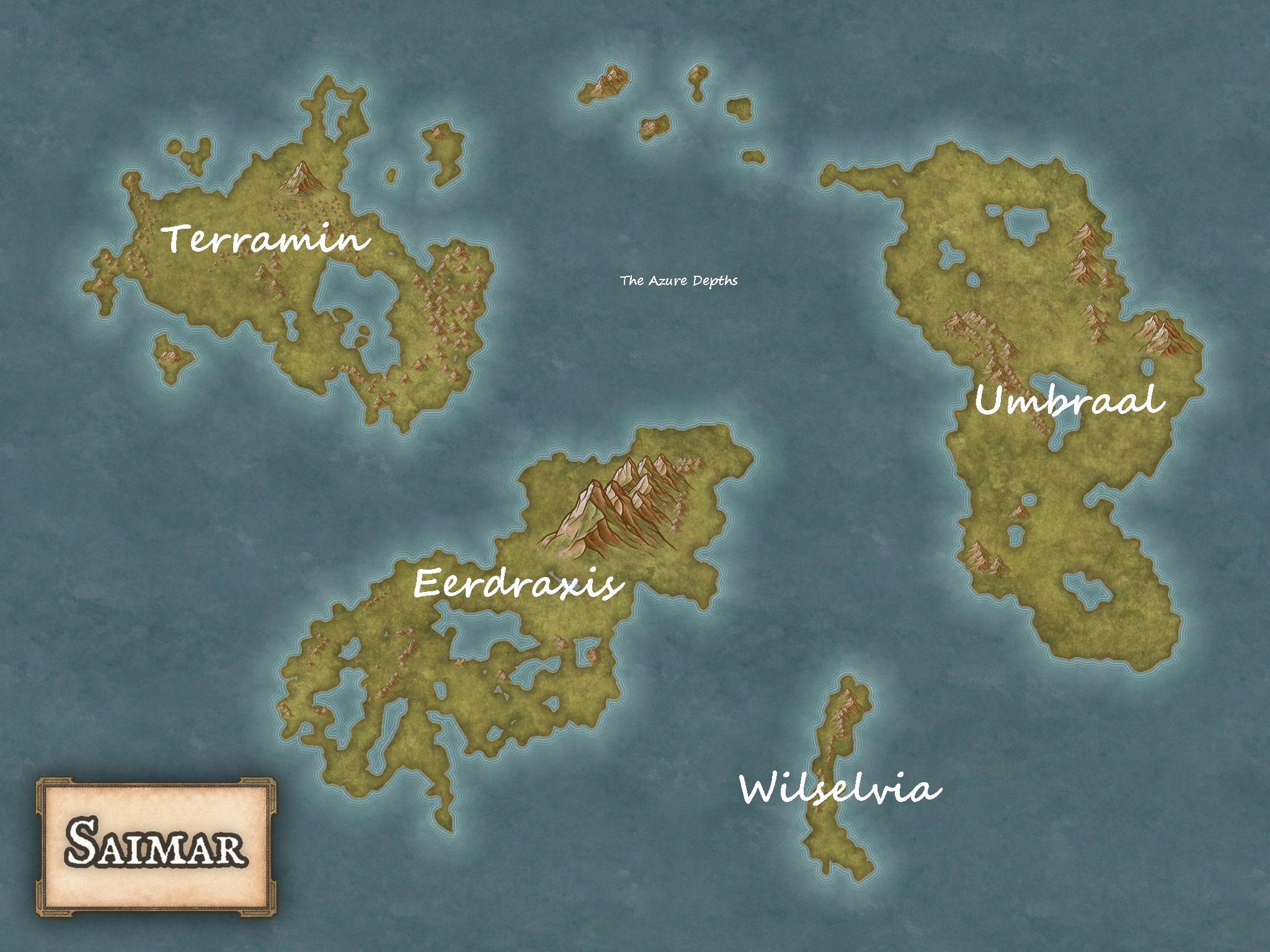
Saimar is the 28th planet from the twin suns and one of XB1287’s two inhabited worlds. Its four continents are Umbraal, Eerdraxis, Terramin and Wilselvia.
All 128 umbras lie on the continent of Umbraal. These territories were formerly referred to as nations. Each umbra is a fully self-sustaining society capable of providing all of its own resources.
The Council of Equilibrium governs from Shadowspire, Saimar’s capital city and Umbra 1.
Terramin, Eerdraxis, Umbraal and Wilselvia surround the Azure Depths.
Eerdraxis, a vast and untamed landmass, lies to the west of Wilselvia. Equal in size to the continent of Umbraal, it is both awe-inspiring and terrifying, known as the dominion of dragons. The continent is home to thousands of these majestic and fearsome creatures, representing nearly every known draconic species. It is a realm where the laws of nature bend to the will of ancient, powerful beings, untouched by humanoid influence.
The geography of Eerdraxis is dominated by the Drakenspire Mountains, the largest mountain range on Saimar, which stretches across the northern reaches of the continent. These towering peaks, shrouded in perpetual mist and storms, are the nesting grounds for countless dragons. The range is said to house ancient caves, some large enough to hold entire cities, though no humanoid has ever dared to venture into them and lived to tell the tale. The peaks are the ultimate symbols of draconic dominance, with individual dragons claiming entire mountain ranges as their personal territories. Legends speak of an enormous dragon, the Elder Wyrm, who slumbers deep within the Drakenspire, its very breath influencing the winds and weather of the region.
The southern half of Eerdraxis presents a different but equally hostile environment. Here, a network of colossal lakes and marshlands stretches across the landscape, interspersed with smaller mountain ranges that house younger or lesser dragon species. The largest of these lakes, Lake Dravarn, is said to be so vast that its depths remain uncharted, and it serves as the home to aquatic dragons and other primordial creatures. The surrounding marshes are known for their treacherous terrain, as well as the presence of territorial dragonkin and other draconic offspring. These regions are no less dangerous than the northern peaks, with acid-spewing black dragons and venomous green dragons reigning supreme over the swamplands.
The Legacy of Eerdraxis
Eerdraxis is a land steeped in legend and fear, its very name conjuring images of towering, fire-breathing beasts that once terrorized the ancient civilizations of Saimar. Though dragons now keep mostly to themselves on their home continent, their influence is felt far beyond its shores. Ancient records speak of times when dragons would leave Eerdraxis to pillage or claim lands in other parts of the world. These raids shaped the history and mythologies of every race on Saimar, as kingdoms rose and fell under the shadow of dragonkind.
Today, the dragons of Eerdraxis remain largely secluded, ruling over their isolated realm with absolute authority. Many scholars debate why the dragons withdrew to this continent, with some suggesting that they seek to safeguard their ancient treasures and hoards from mortal hands. Others propose that they are preparing for a future conflict, perhaps waiting for a time when their numbers and strength are greater than ever before.
A Forbidden Land
The sheer dominance of dragons has made Eerdraxis a place of exile for intelligent humanoids. No nation or society on Saimar dares to explore or colonize the continent, for fear of incurring the wrath of its draconic overlords. The last recorded attempt to explore the continent ended in disaster nearly 500 years ago when an expedition from the now-forgotten kingdom of Yllistrad was devastated. Reports of the survivors, who were few, tell of dragons descending from the sky in a flurry of fire and destruction, leaving no trace of their fleet or its ambitions.
Even the seas around Eerdraxis are considered perilous, as dragons are known to patrol their coastal territories. Ships that stray too close are often destroyed without warning, their wreckage left as a grim reminder to those who would challenge the continent’s sovereignty. As a result, no humanoid expeditions are known to have reached Eerdraxis in centuries, and it has become a land of myth, a place spoken of only in hushed tones or daring stories of adventure.
The Draconic Hierarchy
Eerdraxis is not a lawless realm. Despite the chaotic nature of dragonkind, a strict draconic hierarchy governs the continent. The eldest and most powerful dragons, known as the Ancients, command immense respect and authority. These beings, some of whom are said to have been born at the dawn of Saimar itself, reside in the highest peaks of the Drakenspire Mountains. They are the arbiters of draconic law, mediating disputes between younger dragons and deciding the fate of those who defy the established order.
Dragons of lesser age and power occupy the lower peaks, foothills, and southern marshes, but even among these younger dragons, status is determined by age, power, and wealth. The younger dragons spend much of their lives accumulating hoards of gold, gems, and magical artifacts, all in a bid to increase their standing in the eyes of their more powerful kin.
The Influence of Dragons on Saimar
Though humanoids avoid Eerdraxis, the influence of dragons is still felt across Saimar. Dragon sightings near the borders of other continents, particularly Umbraal, are not unheard of, and many believe that dragons continue to play a silent role in the political and magical landscape of the world. Some speculate that the powerful artifacts found in ancient ruins are relics of dragons that once ruled lands beyond Eerdraxis, hinting at a forgotten past where dragons directly shaped the world.
The existence of dragon cults, secretive groups that worship these ancient creatures, further fuels the mystery surrounding Eerdraxis. These cults believe that dragons are destined to one day reclaim dominion over the entire planet, and they actively seek to curry favor with the beasts, sometimes even attempting to make contact with the lesser dragons of the southern marshes.
The legacy of dragonkind
Eerdraxis stands as a living testament to the power and majesty of dragonkind. It is a continent shaped by fire and magic, a land where outsiders dare not tread. While its shores remain closed to outsiders, the legacy of its draconic inhabitants continues to influence the world of Saimar, a constant reminder of the ancient creatures that dwell within its mountainous peaks and marshy depths.
Terramin, a continent in the northwestern hemisphere of Saimar, is a wild and untamed land, shrouded in mystery and danger. Slightly smaller than the known continent of Umbraal, Terramin remains largely unexplored by the civilized peoples of Saimar. From its inception, this region has been teeming with monstrous creatures, instilling fear in the hearts of adventurers and scholars alike. Terramin’s harsh and unpredictable nature, combined with rumors of fearsome beasts and powerful unknown forces, has deterred even the bravest from venturing into its depths.
Many maps of Saimar leave Terramin as a blank, uncharted region, marked only with warning symbols and cryptic notes passed down from the few who have dared to explore its fringes. Though some distant sightings suggest towering mountain ranges, dense forests, and dark rivers coursing through the land, much of Terramin’s landscape remains a mystery.
Legends abound of ancient beasts, long-lost relics, and civilizations that predate even the gods’ creation of Saimar, hidden deep within its monstrous wilderness. But for now, Terramin is a place of speculation—a blank canvas for those brave enough to unlock its secrets. As Saimar continues to grow, whispers of an expedition to Terramin grow stronger, with adventurers, explorers, and scholars beginning to wonder what treasures or terrors await those bold enough to step into the unknown.
Wilselvia is the smallest continent on Saimar, known for its elongated, narrow shape and mystical aura. Geographically, it is considered an island due to its isolation from the larger landmasses of the planet, yet its size and cultural significance elevate it to continental status. Half the size of Australia on Earth, Wilselvia's most striking geographical feature is the Drenarian Mountains, a vast range that spans the northern half of the continent. These peaks are ancient, and legends speak of them being shaped by the hands of forgotten gods. The southern half of the continent, in contrast, is composed of rolling plains, dense forests, and hidden coves.
The mountains themselves are not just geological features; they are steeped in powerful, ancient magic. The Winds of Drenar, a mystical force said to reside in the upper reaches of the mountains, are believed to be a remnant of primordial magic that predates the known history of Saimar. Scholars theorize that this is why Wilselvia is so closely tied to the magical energies of the world. The land pulses with a power that is not only tangible but often unpredictable, warping the natural laws in subtle ways. Storms may bring showers of silver droplets, trees may shimmer with an ethereal glow, and rivers occasionally run backward.
The Call of Ages: Elven Pilgrimage
Wilselvia holds a special place in the hearts of the elves of Saimar. It is said that when an elf has lived several centuries, a deep, almost instinctual yearning arises within them — a pull toward Wilselvia, known as the Call of Ages. This pilgrimage is seen as a sacred rite, a journey of reflection, renewal, and ultimately, transcendence. Upon arrival in Wilselvia, elves often seek out the secluded regions of the Drenarian Mountains, where they believe they can commune with the essence of the world itself.
According to elven tradition, those who make the journey are known as Viltharion, meaning "Seekers of the Last Light." They often go to live out the remainder of their lives in peace, but there are whispered tales of some elves discovering a hidden power in the mountains, granting them immortality or transformation into beings of pure magic. Whether true or myth, these stories have become a central part of Wilselvia's enigmatic allure.
Magical Confluence
Wilselvia is not just a place for elderly elves but a destination for scholars and mages from all corners of Saimar. The island's unique magical properties make it a hub for magical study. The Arcane Conclave of Lios'Thar, located on the southern plains, is one of the oldest magical academies in the world, where students are trained to harness the chaotic forces that surge through the land. Unlike many other magical institutions, which focus on control and predictability, the Conclave encourages students to experiment with the wild, unpredictable nature of Wilselvia’s magic, believing that true mastery comes from understanding the very essence of the arcane itself.
Wilselvia is home to the Evertide Forest, a mysterious woodland that stretches from the base of the mountains toward the southern coast. Time within the forest is said to flow differently, with travelers reporting that days pass in mere hours or weeks pass in moments. The heart of this forest contains the Evertide Glade, a place where reality is thin, and the veil between the material world and other planes weakens. Many mages journey here, hoping to catch glimpses of otherworldly realms or communicate with beings from distant dimensions.
Guardians of the Island
Despite the continent’s magical renown, it is not without its protectors. The Rangers of Wilselvia are an order of warriors and mages dedicated to preserving the balance of the island’s magic. Unlike typical rangers, these guardians are trained in both martial and arcane arts, using the chaotic magic of Wilselvia to defend it from intruders who might seek to exploit its power. Though few in number, they are widely respected across Saimar and often serve as guides for pilgrims and scholars venturing into the island’s depths.
The island is home to an ancient race of sentient beings known as the Vilnari, mysterious humanoid creatures that are rarely seen but are rumored to live deep within the mountain caves. The Vilnari are said to be as old as the magic that courses through Wilselvia itself, and many believe they act as the true stewards of the island, ensuring that its powerful forces are not disturbed.
The enduring mystery
Wilselvia remains a place of wonder, danger, and unparalleled magical significance. Whether it is the pilgrimage of aging elves, the scholarly pursuits of the Arcane Conclave, or the dangerous allure of its untamed magic, the island stands as a testament to the mysteries of Saimar. To set foot on its shores is to step into a world where reality itself bends to the will of the arcane, and where the very air hums with the pulse of ancient power.
Umbraal is the continent of Saimar that contains all 128 umbras. An umbra is a territory formerly referred to as a nation; each is a self-sustaining society capable of providing its own resources.
Shadowspire is Umbra 1 and the capital city of Saimar. It is also the seat of the Council of Equilibrium.
Shadowspire is the capital city of the planet Saimar, located in the XB1287 solar system. Renowned for its commitment to equality, peace, and well-being, Shadowspire serves as a beacon of hope and prosperity shaped by the Shadow God, Malaggar. With a population of approximately 310,000 residents, the city is a harmonious blend of diverse races, cultures, and traditions, all governed under a unique political system that prioritizes the welfare of its citizens.
Shadowspire is Umbra 1 on Umbraal. Formerly part of Karendul, it is the only umbra that consists of a single city. Its sigil represents Malaggar, Shadowspire, and Saimar.
Population
310,000
Settlement
Metropolis
Umbra
1 · Shadowspire
Former nation
Karendul
Alignment
Neutral
Government
Council of Equilibrium
The Council of Equilibrium governs through an informed popular-vote democracy. Citizens answer questions about each issue on which they vote. A score of at least 72% is required for a vote on that specific issue to count.
All faiths are represented, with particular devotion to Malaggar, Alfari, and Dalnos.
Crime is very low: 38.3 reported crimes per 100,000 residents each year, including 8.4 violent crimes.
Umbra 2 is one of the 128 umbras on Umbraal, a continent of Saimar.
Former nation
Thraldurak
Majority population
Dwarves (85%)
Other peoples
Humans, Gnomes
Location
Umbraal, Saimar
Umbra 3 is one of the 128 umbras on Umbraal, a continent of Saimar.
Former nation
Elandriel
Majority population
Elves (70%)
Other peoples
Half-Elves, Humans
Location
Umbraal, Saimar
Umbra 4 is one of the 128 umbras on Umbraal, a continent of Saimar.
Former nation
Gorush
Majority population
Orcs (65%)
Other peoples
Half-Orcs, Goblins
Location
Umbraal, Saimar
The Sigil of Keen Understanding
Umbra 5, situated directly east of the capital city, Shadowspire (Umbra 1), is a thriving and dynamic area with a diverse population. The umbra is composed of 75% humans, with significant communities of dwarves and halflings, as well as smaller populations of elves, half-elves, and other races. Like Umbra 1, it was formerly part of the nation of Karendul, which has shaped its cultural and social landscape.
Its emblem is also known as the Sigil of Truth in Wisdom. Crestfall, in Luminal Parish, serves as the umbra capital.
Recorded population
188,000
Capital
Crestfall
Location
East of Shadowspire · Umbraal
Former nation
Karendul
Alignment
Neutral
Settlements
4 cities · 17 towns · 24 villages
The Council of Equilibrium governs through an informed popular-vote democracy. Citizens answer questions about each issue on which they vote. A score of at least 72% is required for a vote on that specific issue to count.
All faiths are represented, with particular devotion to Malaggar, Alfari, and Dalnos.
Crime is very low: 29.2 reported crimes per 100,000 residents each year, including 5.5 violent crimes.
Saimar has 128 umbras, all on the continent of Umbraal. These territories were formerly referred to as nations. The directory records each umbra’s former nation, majority population and other peoples.
Umbra 1 is Shadowspire, the capital of Saimar. The directory tables record majority percentages; expanded profiles for Shadowspire and Umbra 5 include their communities, landmarks, history, and daily life.
The Council of Equilibrium has twelve members. Together, they oversee the affairs of Shadowspire and Saimar, with each office responsible for a distinct part of public life.
The twelve offices of Saimar’s governing council
Office
Responsibilities
High Arbiter
Leads the council, oversees its activities and ensures that its decisions uphold balance and justice. Serves as Shadowspire’s primary representative in global matters.
Chancellor of Harmony
Maintains peace within Shadowspire and across Saimar by mediating disputes and encouraging cooperation among factions and communities.
Minister of Justice
Oversees the legal system, ensuring that laws are fair and just. Supervises the courts and law enforcement agencies to keep them free of corruption.
Minister of Progress
Advances technology and society through innovation, education and sustainable development, helping the city and planet thrive.
Minister of Health
Protects the well-being of all citizens by overseeing healthcare services, public health initiatives and environmental health.
Minister of Resources
Manages Saimar’s natural resources, including agriculture, water and energy, to ensure sustainable and equitable use.
Minister of Culture
Preserves Saimar’s heritage and promotes cultural life through the arts, education and cultural exchange programs.
Minister of Defense
Protects Shadowspire and Saimar by overseeing the defense forces and coordinating with other cities to maintain global peace.
Minister of Commerce
Manages trade and economic policy to maintain a strong economy that benefits all citizens. Oversees markets, trade agreements and economic development.
Minister of Infrastructure
Oversees the development and maintenance of Shadowspire’s transportation systems, communication networks and public buildings.
Minister of Foreign Affairs
Manages relations with other planets and entities within XB1287 through diplomacy, trade negotiations and interplanetary cooperation.
Minister of Science and Exploration
Promotes scientific research and exploration by supporting scientific institutions, space exploration and the study of the solar system.
Deliberation and voting
The council meets regularly to discuss and decide matters affecting Shadowspire and Saimar. Decisions are made through a democratic vote, with each member holding an equal vote. The High Arbiter has the authority to break ties when necessary.
Public accountability
The council operates transparently, holding regular public forums and issuing reports so citizens can stay informed and participate in governance. This openness helps maintain trust and accountability.
Advisory committees
Each minister may form committees of experts and citizens to offer insight and recommendations on specific issues.
Citizen participation
Citizens have ways to propose laws, policies and changes, keeping the government responsive to the needs and wishes of the people.
Ethics oversight
An independent ethics committee monitors the council’s activities to prevent corruption and ensure that its actions uphold justice and balance.
Informed public voting
The Council of Equilibrium governs through an informed popular-vote democracy. Citizens answer questions about each issue on which they vote. A score of at least 72% is required for a vote on that specific issue to count.
Luminal Parish is where the main governmental activities occur, housing bureaucrats, diplomats, and lawmakers. It’s also home to civic courts and administrative offices for Saimar's 128 umbras and Shadowspire’s 6 parishes.
Population
50,000
Purpose
Government and administration
Places and landmarks
Purpose. Administrative and governmental center.
Features. Home to the Council of Equilibrium's chambers, city archives, and diplomatic embassies from other districts or factions.
Landmarks. The Council Hall, a towering spire of crystal and stone, symbolizing balance, and the largest public forum for debates and gatherings.
The people
Luminal Parish demographics
Community
Population
Share
Humans
35,000
70%
Elves
7,500
15%
Dwarves
2,500
5%
Other Races
5,000
10%
Leadership
Council of Equilibrium. The highest governing body of the umbra. Composed of 12 members representing different sectors of society.
Council Head. Oversees the balance of power in the umbra. The position rotates to maintain balance.
Councilors of Law. 2 councilors focused on judicial matters and lawmaking.
Councilors of Finance. 2 councilors managing taxation, treasury, and public spending.
Councilors of Infrastructure. 2 councilors focused on city planning and public works.
Councilors of Civil Rights. 2 councilors ensuring equality and fairness across races and social classes.
Councilors of Defense. 2 councilors overseeing defense and city guards.
Councilors of Foreign Affairs. 2 councilors managing relations with other umbras and distant lands.
Mendris Parish is dedicated to providing medical services, mental health support, education on health, and social programs. The hospitals, orphanages, and social service offices are located here.
Population
45,000
Purpose
Healing and support
Places and landmarks
Purpose. Home to healers, hospitals, and social services.
Features. Hospitals, public kitchens, orphanages, and educational facilities for medicine and social work.
Landmarks. The "Circle of Care," a grand circular building where the city's healers and caretakers convene, and the Great Hospice.
The people
Mendris Parish demographics
Community
Population
Share
Humans
24,750
55%
Half-Elves
9,000
20%
Halflings
4,500
10%
Other Races
6,750
15%
Leadership
High Minister of Health. The primary leader overseeing all healthcare initiatives.
Council of Healers. 6 members:
Chief Medical Officer. Head of the main hospital.
Head of Social Services. Oversees welfare programs, food distribution, and housing.
Master of Magical Healing. In charge of the city’s arcane healing efforts.
Lead Psychiatrist. In charge of mental health services and well-being.
Coordinator of Orphanages. Manages care for orphans and children.
Coordinator of Education. Ensures that public health and well-being are taught citywide.
Aetherfall Parish is the spiritual heart of Shadowspire, housing the grand Shadow Temple dedicated to Malaggar the Shadow God, along with many smaller temples for other deities. It is a place of worship, pilgrimage, and spiritual study.
Population
40,000
Purpose
Faith and spiritual life
Places and landmarks
Purpose. Spiritual heart of the city.
Features. Temples, shrines, and places of worship to various deities (including a grand temple to Malaggar the Shadow God).
Landmarks. The Shadow Temple, dedicated to Malaggar the Shadow God, and the Celestial Falls, a mystic waterfall said to have divine properties.
The people
Aetherfall Parish demographics
Community
Population
Share
Humans
20,000
50%
Half-Orcs
8,000
20%
Elves
4,000
10%
Other Races
8,000
20%
Leadership
High Priest of the Shadow Temple. Oversees the worship of Malaggar the Shadow God.
Council of Faith. 7 members:
Priest of Malaggar. Head of the largest temple to the Shadow God.
Cleric of Equilibrium. A representative of the god’s teachings focused on maintaining balance in daily life.
Missionary Leader. Coordinates spiritual outreach efforts across the city and other umbras.
Keeper of the Sacred Texts. Responsible for maintaining and protecting ancient religious texts.
Religious Architect. Oversees the upkeep and expansion of the religious buildings.
Ceremonial Leader. Organizes citywide ceremonies, festivals, and rituals.
Head Monk. Represents the monastic orders who practice spiritual meditation and discipline.
Forgesoul Parish is where all crafting, blacksmithing, and manufacturing happen. It's a bustling district with forges, factories, and artisan workshops producing goods for the city and trade.
Population
55,000
Purpose
Industry and crafting
Places and landmarks
Purpose. The crafting and manufacturing hub of Shadowspire.
Features. Blacksmiths, alchemists, artisans, and factories.
Landmarks. The Great Forge of Balance, a massive structure where master crafters create the finest weapons, armor, and tools.
The people
Forgesoul Parish demographics
Community
Population
Share
Humans
24,750
45%
Dwarves
16,500
30%
Gnomes
5,500
10%
Other Races
8,250
15%
Leadership
Master Artificer. Leads the industry of crafting and technological innovation.
Council of Crafters. 8 members:
Head Blacksmith. Oversees the city's weapon and armor production.
Grand Alchemist. In charge of potion and alchemical production.
Architect of Forges. Manages the design and upkeep of industrial forges.
Chief Enchanter. Leads magical crafting and enchanting services.
Guildmaster of Artisans. Represents the various artisan guilds.
Master Engineer. Responsible for mechanical creations, including the city's transportation systems.
Merchant Overseer. Manages trade within the crafting community.
Warehouse Coordinator. Oversees the storage and distribution of resources.
Verdanspire Parish manages the city’s food production, trade, and markets. It includes fertile fields, farms, and greenhouses, ensuring the parish remains well-fed and connected to the outside world.
Population
65,000
Purpose
Agriculture and trade
Places and landmarks
Purpose. Center for food production, trade, and commerce.
Features. Markets, agricultural fields (both inside and outside the city), trade guild halls, and commercial districts.
Landmarks. The Verdant Spire, a tall tower surrounded by terraced gardens and farmland, which serves as a center for agricultural innovation.
The people
Verdanspire Parish demographics
Community
Population
Share
Humans
39,000
60%
Halflings
13,000
20%
Elves
6,500
10%
Other Races
6,500
10%
Leadership
Agrarian Overseer. Leads the city’s food production efforts and agricultural management.
Council of Farmers. 5 members:
Master Farmer. Oversees the various farms surrounding and within the city.
Trade Ambassador. Represents traders and ensures fair exchange of goods.
Chief Brewer. Oversees the production of alcohol, brews, and other culinary exports.
Animal Husbandry Specialist. Manages livestock and animal production.
Market Director. Coordinates the city’s major markets and fairs.
Harmonis Parish is the intellectual and magical center of Shadowspire, housing universities, magical academies, libraries, and research institutions. It is where the brightest minds of the city work together to advance knowledge in magic, science, and history.
Population
55,000
Purpose
Academia and magic
Places and landmarks
Purpose. The academic and magical research center.
Features. Universities, magical academies, and research facilities.
Landmarks. The Arcane University, where both magic and science are studied to promote balance, and the Equilibrium Tower, where scholars and mages collaborate on research. The Museum of Creation is a notable public venue, showcasing the mortal life of Malaggar Tros of Celwynvian.
The people
Harmonis Parish demographics
Community
Population
Share
Humans
30,250
55%
Elves
13,750
25%
Gnomes
5,500
10%
Other Races
5,500
10%
Leadership
Archmage of Equilibrium. The head of magical research and arcane studies.
Council of Knowledge. 7 members:
Dean of Arcane University. Oversees the magical academies and educational institutions.
High Loremaster. Responsible for the preservation and teaching of the city’s history and lore.
Master of Research. Manages all scientific and magical research.
Head of Artifacts. Oversees the study and preservation of ancient magical relics.
Chancellor of Innovation. Focuses on pushing the boundaries of science and magic.
Professor of Applied Magic. Leads the practical application of magical theory in the city.
Cultural Archivist. Responsible for preserving and documenting the various cultural histories within the city.
Each umbra on Saimar is divided into six parishes. Most umbras encompass towns, villages, and cities. Umbra 1 is the exception: Shadowspire is the only umbra that consists of a single city. Parish names and functions can vary between umbras; the following six belong to Shadowspire.
The governance of Shadowspire is led by the Council of Equilibrium, a body composed of twelve representatives elected from all over Saimar. Each representative serves a vital role in ensuring that the voices of their constituents are heard and that the principles of equality and justice are upheld. The council operates under a popular vote democracy, where decisions are made collectively, promoting transparency and active participation among citizens.
This democratic structure allows for direct representation of the populace, with council members tasked with addressing the needs of their respective umbras. The absence of slavery and the abundance of social services contribute to a society where everyone has access to food, shelter, and opportunities for personal growth.
Culture
The culture of Shadowspire is deeply influenced by the teachings of Malaggar, the Shadow God. Citizens celebrate a range of holidays that reflect their values, including Malaggar’s Ascendance Day, which commemorates the day Malaggar ascended to godhood, and Unity Day, celebrating the unification of Saimar’s governments. Other festivities promote community engagement and cultural expression, fostering a sense of belonging among the residents.
Common sayings, such as “Together, We Rise,” embody the spirit of camaraderie and mutual support among the populace. The moral code of the citizens is guided by eleven tenets that promote integrity, respect, and kindness, serving as the foundation for interpersonal relationships and community interactions.
Infrastructure and architecture
Shadowspire is characterized by its striking medieval Gothic architecture, with soaring spires and intricate stonework that give the city a majestic and timeless quality. The Shadow Temple, the central religious structure, is a hallmark of this style, drawing citizens and visitors alike for worship and reflection.
The city’s infrastructure is carefully planned, with wide streets and accessible public spaces that encourage social interaction. Well-maintained roads connect Shadowspire’s parishes and link the city with other umbras. Parks and communal areas provide places for recreation and gatherings.
A peaceful way of life
The inhabitants of Shadowspire enjoy a peaceful existence, supported by a strong social framework that eliminates homelessness and hunger. The absence of poverty is a significant achievement of the governing council, which prioritizes social services and equitable distribution of resources. Citizens actively participate in local governance, ensuring that their needs and concerns are addressed promptly.
Crime rates are remarkably low, as the city's laws are designed to promote harmony rather than punishment. The 99 Laws of Saimar serve as guiding principles, emphasizing the importance of personal responsibility and community welfare. Offenses are met with restorative justice measures, focusing on rehabilitation rather than retribution.
Trade and the economy
Shadowspire's economy thrives on both imports and exports, contributing to the city's prosperity. The primary exports include:
Crafts and Artwork. Renowned for their quality and uniqueness, artisans in Shadowspire produce exquisite crafts, jewelry, and art pieces that are highly sought after in neighboring regions.
Magical Goods. The city is a hub for magical studies, and as such, it exports a variety of magical items and potions created by skilled enchanters and alchemists.
Agricultural Products. Fertile lands surrounding the city yield abundant crops, and Shadowspire supplies grains, fruits, and vegetables to other settlements.
Imports include:
Raw Materials. Due to its focus on craftsmanship, Shadowspire imports metals, wood, and other raw materials necessary for production.
Exotic Goods. Trade routes bring in spices, textiles, and unique items from distant regions, enriching the local market.
Knowledge and Culture. Scholars and mages often travel to and from Shadowspire, bringing with them new ideas and innovations that further enhance the city's intellectual and cultural landscape.
Shadowspire stands as a testament to the possibilities of a society built on equality, justice, and compassion. Under the guidance of Malaggar and the Council of Equilibrium, the city thrives as a place where diverse cultures harmonize, and all citizens are afforded the opportunity to live fulfilling and prosperous lives.
Across Saimar, annual observances honor creation, freedom, remembrance, and the bonds between communities.
Festival of Unity
12th of Calistril (February 12)
This holiday celebrates the diverse cultures and races that inhabit Saimar, emphasizing the importance of collaboration and understanding among all peoples. It is a time for citizens to come together and showcase their unique traditions, foods, and arts.
Cultural Exhibitions. Each race and culture sets up booths in the main square to showcase traditional crafts, foods, and performances.
Inter-Parish Relay. A friendly relay race that passes through all parishes, symbolizing teamwork and unity across umbras.
Harmony Songs. Musicians from different backgrounds collaborate to create and perform songs that blend various musical styles.
Malaggar's Ascendance Day
15th of Desnus (May 15)
Celebrates the day Malaggar became a demigod in 5928 AR after completing the Test of the Starstone on Golarion. The people of Saimar honor their creator with ceremonies at the Shadow Temple and throughout the city. Rituals of balance, shadow dances, and a citywide festival mark the day.
Night of Shadows. A citywide candlelit parade where people honor the balance between light and dark.
Offerings of Balance. Citizens bring symbolic items representing both light and darkness to the temples.
Temple Feast. The Council of Equilibrium hosts a grand feast for all citizens.
Unity Day (The Globalization of Saimar)
2nd of Sarenith (June 2)
Celebrates the unification of Saimar's government under the Council of Equilibrium and the establishment of the popular vote democracy. This day represents true freedom, equality, and the end of all internal conflict.
Council Speeches. Representatives from the 128 umbras give speeches celebrating freedom and cooperation.
Free Feast. A massive open banquet in every umbra celebrating the equality of all citizens, hosted by a different parish each year.
Parish Games. Friendly competitions between the parishes, symbolizing unity in diversity.
Day of Equilibrium
23rd of Rova (September 23)
This day celebrates the perfect balance between day and night on Saimar and honors the teachings of Malaggar regarding balance in all things. Citizens reflect on equilibrium in their personal lives and their society.
Equinox Meditation. Citizens gather in parks and temples to meditate and reflect on maintaining balance.
Duality Tournaments. A series of physical and mental challenges testing balance and agility.
Equilibrium Offerings. Citizens place symbolic items at temple altars representing harmony in their lives.
Freedom’s Tide
17th of Lamashan (October 17)
A celebration of the abolition of slavery across Saimar, marking the day when the last slave on the planet was freed, ensuring that all citizens live equally.
Freedom March. A grand parade where citizens carry banners representing liberty.
Storytelling Circles. Survivors and descendants of those once enslaved tell stories to honor the struggles of the past and the triumph of freedom.
Unchained Ceremony. A symbolic breaking of chains ceremony held in every parish.
Embernight Vigil
7th of Neth (November 7)
This solemn holiday commemorates the struggles and sacrifices made by the people of Saimar in their pursuit of freedom and equality. It serves as a reminder of the importance of vigilance in maintaining the peace and balance established in society.
Candlelight Vigils. Citizens light candles in memory of those who fought for freedom and justice, gathering in public spaces for reflection.
Storytelling Night. Communities share stories of bravery, resilience, and hope, fostering a sense of connection and remembrance.
Oath of the Vigil. The leaders of each parish renew their vows to protect and serve the citizens, ensuring that the principles of freedom and equality are upheld.
Starfall Festival
1st of Kuthona (December 1)
A celebration of the creation of the XB1287 solar system by Malaggar after his ascension. This marks the beginning of Saimar’s new era, with the planet and its people flourishing under the protection of their god.
Celestial Displays. Magic users across the city create light shows mimicking the birth of the stars Alfari and Dalnos.
Skyward Feast. A meal held at the tops of towers and rooftops, symbolizing the connection to the heavens.
Starfall Gifts. Citizens exchange small, symbolic gifts representing the stars and celestial wonders.
Alfari and Dalnos: Once every 1,000 years, the two deities appear on Saimar for a day together. Their next reunion is recorded for the 1st of Kuthona, 8009 AR.
The eleven tenets
Honor the Balance. Strive for equilibrium in all aspects of life, respecting both light and shadow in oneself and others.
Uphold Freedom. Protect the freedom of all individuals, recognizing that true liberty is the foundation of a just society.
Embrace Diversity. Celebrate and respect the varied cultures, beliefs, and traditions that contribute to the richness of Saimar.
Speak with Integrity. Communicate truthfully and openly, ensuring that every voice is heard and valued in the community.
Foster Community. Support one another and work collaboratively for the common good, nurturing strong bonds within neighborhoods, across parishes, and throughout the umbras.
Promote Knowledge. Seek knowledge and wisdom, sharing insights to uplift others and advance the collective understanding of society. Knowledge should always guide us.
Practice Compassion. Show kindness and empathy towards others, recognizing the struggles and triumphs of those around you.
Defend the Vulnerable. Stand up for those who cannot defend themselves, ensuring that all citizens are treated with dignity and respect.
Cherish Life. Value all forms of life and work to protect the environment, understanding that the health of the land is intertwined with the well-being of its people.
Commit to Justice. Advocate for fairness and equality, ensuring that every individual has access to opportunities and resources without discrimination.
Honor the Past, Build the Future. Acknowledge the sacrifices and achievements of those who came before, using their lessons to guide the creation of a better tomorrow for all.
Traditional sayings
“In Balance We Thrive.”
This saying emphasizes the importance of equilibrium in life and governance, reflecting the teachings of Malaggar and the harmonious coexistence of different races and cultures.
“Freedom is Our Foundation.”
A reminder that the freedom enjoyed by the citizens of Saimar is built upon the sacrifices and struggles of those who came before them, reinforcing their commitment to maintaining that freedom.
“Together, We Rise.”
This phrase highlights the strength found in unity and collaboration among the diverse populations of Saimar, encouraging people to support one another in achieving their goals and overcoming challenges.
“From Many, One.”
This saying reflects the idea that the strength of Saimar comes from its diverse population, uniting various races and cultures into a single, harmonious society.
“The Shadow Guides Us.”
Acknowledging the influence of Malaggar, this phrase suggests that the teachings of the Shadow God provide wisdom and guidance in navigating life’s challenges.
“Hope Illuminates the Dark.”
This saying serves as a reminder that even in difficult times, hope and resilience can light the way forward, inspiring citizens to remain optimistic and determined.
“Unity in Diversity.”
Celebrating the variety of cultures and backgrounds within Saimar, this phrase emphasizes the strength found in differences, encouraging collaboration and mutual respect.
“Every Voice Matters.”
A reflection of the democratic values in Shadowspire, this saying underscores the importance of every citizen's input in the decision-making process and the responsibility to speak up for one's community.
The 99 Laws of Saimar guide civic life across the planet. Shadowspire’s justice system emphasizes community welfare, rehabilitation, and restorative justice.
No Intentional Harm. Causing physical or emotional harm to another is punishable.
No Theft. Taking someone else's property without permission is illegal.
No Assault. Physical aggression towards others is prohibited.
No Murder. Taking another’s life is a grave offense.
No Fraud. Deceiving others for personal gain is punishable.
No Discrimination. Treating individuals unfairly based on race, gender, or background is illegal.
No Public Disorder. Causing disturbances in public spaces disrupts peace.
No Vandalism. Defacing or destroying property is punishable.
No Bribery. Offering or accepting bribes to influence decisions is illegal.
No Corruption. Abusing positions of power for personal gain is punishable.
No Kidnapping. Illegally taking or holding someone against their will is a serious crime.
No Domestic Abuse. Violence or abuse within the home is strictly prohibited.
No Harassment. Bullying or stalking individuals is illegal.
No Substance Abuse. Possessing or distributing controlled substances without permission is punishable.
No Hate Speech. Promoting violence or hatred against individuals or groups is prohibited.
No Public Nudity. Exhibiting nudity in public spaces without consent is illegal.
No Invasion of Privacy. Trespassing or spying on individuals is punishable.
No Disruption of Assembly. Interfering with lawful gatherings is against the law.
No Fraudulent Documentation. Creating or using fake documents is illegal.
No Unlicensed Businesses. Operating a business without the necessary permits is punishable.
No Environmental Destruction. Causing harm to the environment is illegal.
No Endangerment. Recklessly putting others in danger is a punishable offense.
No Ignoring Safety Regulations. Failing to adhere to safety laws puts lives at risk.
No Spreading False Information. Disseminating lies that cause harm is punishable.
No Falsifying Evidence. Tampering with evidence in any legal matter is illegal.
No Obstruction of Justice. Interfering with law enforcement or legal proceedings is punishable.
No Smuggling. Illegally transporting goods across borders is a serious crime.
No Illegal Gambling. Engaging in unregulated gambling activities is prohibited.
No Disturbing the Peace. Loud and disruptive behavior in public spaces is punishable.
No Disrespect to Authority. Insulting or assaulting public officials is illegal.
No Tampering with Public Records. Altering official documents is punishable.
No Unauthorized Use of Magic. Practicing magic without proper authorization is illegal.
No Counterfeiting. Producing fake currency or goods is a serious offense.
No Engaging in Slave Trade. Participating in any form of slavery is strictly prohibited.
No Cultivation of Harmful Plants. Growing dangerous or prohibited flora is illegal.
No Animal Cruelty. Mistreating or abusing animals is punishable.
No Public Intoxication. Being excessively intoxicated in public places is illegal.
No Illegal Entry. Trespassing on private property is punishable.
No Unauthorized Surveillance. Monitoring others without their consent is illegal.
No Disturbing Rituals. Interfering with religious ceremonies is punishable.
No Engaging in Witch Hunts. Accusing individuals without evidence is illegal.
No Public Urination. Failing to use designated restrooms in public is punishable.
No Distribution of Obscene Material. Sharing inappropriate content is illegal.
No Violating Contractual Obligations. Failing to adhere to contracts without cause is punishable.
No Misleading Advertising. Promoting false information in business practices is illegal.
No Interfering with Legal Proceedings. Disrupting trials or legal hearings is punishable.
No Impersonating Officials. Pretending to be a government official is illegal.
No Failing to Report Crimes. Not informing authorities of known crimes is punishable.
No Engaging in Unlicensed Combat. Fighting without consent or regulation is illegal.
No Using Forbidden Technology. Employing prohibited technological devices is punishable.
No Promoting Cults. Leading or promoting dangerous cults is illegal.
No Failing to Rescue. Not assisting those in danger when able is punishable.
No Coercion. Forcing others to act against their will is illegal.
No Unjust Enrichment. Gaining wealth at the expense of others is punishable.
No Public Deception. Misleading the public for personal gain is illegal.
No Violating Community Standards. Failing to adhere to community norms is punishable.
No Disruption of Trade. Interfering with commerce or trade activities is illegal.
No Performing Unauthorized Surgery. Conducting medical procedures without a license is punishable.
No Espionage. Stealing secrets or information from others is illegal.
No Trespassing in Sacred Spaces. Entering religious sites without permission is punishable.
No Misinformation. Spreading false information that causes panic or harm is illegal.
No Complicity in Crime. Aiding and abetting criminal activity is punishable.
No Failure to Pay Debts. Evading financial obligations is illegal.
No Selling Prohibited Items. Trading in illegal goods is punishable.
No Failing to Maintain Public Health Standards. Ignoring health regulations is illegal.
No Sharing Confidential Information. Disclosing private data without consent is punishable.
No Plagiarism. Claiming another’s work as your own is illegal.
No Ignoring Civic Duties. Failing to participate in community obligations is punishable.
No Violation of Personal Agreements. Breaking personal promises without cause is illegal.
No Hosting Illegal Gatherings. Organizing unregulated events is punishable.
No Endangering Children. Putting minors in harm's way is illegal.
No Hoarding Resources. Accumulating essential supplies to the detriment of others is punishable.
No Promoting Violence. Encouraging violent actions against others is illegal.
No Spreading Conspiracy Theories. Disseminating unfounded rumors that incite fear is punishable.
No Violating Workplace Safety. Ignoring safety regulations in work environments is illegal.
No Engaging in Blackmail. Coercing others through threats is punishable.
No Falsifying Identity. Using a false identity for personal gain is illegal.
No Supporting Terrorism. Aiding or abetting terrorist activities is punishable.
No Obstructing Emergency Services. Interfering with first responders is illegal.
No Illegally Collecting Debts. Using force or intimidation to collect debts is punishable.
No Making Threats. Verbally or physically threatening others is illegal.
No Violating Trade Agreements. Disregarding mutually agreed-upon trade terms is punishable.
No Failing to Report Abuse. Ignoring knowledge of abuse is illegal.
No Distracting Law Enforcement. Diverting attention from law enforcement activities is punishable.
No Performing Unauthorized Experiments. Conducting experiments without approval is illegal.
No Defamation. Damaging someone’s reputation through false claims is punishable.
No Violating Animal Rights. Disregarding the well-being of animals is illegal.
No Engaging in Unregulated Science. Practicing science without adherence to ethical standards is punishable.
No Exploiting Vulnerable Populations. Taking advantage of those in difficult circumstances is illegal.
No Failing to Report Violations. Ignoring laws and not reporting violations is punishable.
No Causing Public Panic. Actions that incite fear in the public are illegal.
No Promoting Illegal Substances. Encouraging the use of controlled substances is punishable.
No Creating Unsafe Environments. Failing to ensure safety in public spaces is illegal.
No Misusing Public Funds. Using government resources for personal gain is punishable.
No Engaging in Hate Crimes. Acts motivated by hatred towards individuals or groups are illegal.
No Performing Unauthorized Performances. Entertaining without permission in public spaces is punishable.
Weapons Must Be Peace-Tied. Weapons carried in public areas must be peace-tied.
No Failing to Follow Health Guidelines. Ignoring public health measures during crises is punishable.
No Engaging in Revenge Acts. Acting out of vengeance against others is illegal.
Origins: The Legendary Battle (6228 AR)
The history of Shadowspire begins with the momentous battle that took place at its future site in 6228 AR. A powerful lich, known as Olgog, sought to achieve immortality through dark and forbidden means. The lich’s cruel regime involved the mass production of humans, whom he sacrificed to fuel his immortality.
A band of heroes rose against Olgog, led by a paladin named Sir Edrin, determined to liberate the enslaved towns and end the lich’s tyranny. After a fierce battle, the heroes imprisoned Olgog in magical chains beneath the earth. The site was deemed sacred and chosen as the location of the future city of Shadowspire.
The Founding of Shadowspire (6228 AR)
The founding of Shadowspire was marked by the gathering of various races, including humans, elves, dwarves, and halflings, all drawn by the promise of a new beginning. Under Malaggar's guidance, the city was built with an emphasis on harmony and community, with the towering Shadow Temple at its center, serving as a symbol of the divine protection that surrounded the city.
The Early Years: A Growing Community (6228–6674 AR)
For the next few centuries, Shadowspire grew steadily as a center for trade, knowledge, and cultural exchange. As the city flourished, it developed a unique governance structure, where representatives from various races could voice their concerns.
During this period, the city’s population increased, leading to the growth of its parishes and surrounding settlements. Citizens embraced cooperation and mutual respect, living by the moral tenets that shaped their society. Shadowspire became a sanctuary for those seeking refuge from oppression, and its reputation as a fair and just city spread throughout Saimar.
The Age of Fragmentation (6675–6934 AR)
Despite its growth, the years leading up to globalization were marked by a series of challenges. Tensions arose between different racial communities, as historical grievances and misunderstandings threatened to undermine the harmony that had been established.
The Council of Equilibrium, formed to represent the diverse voices of the citizens, faced significant challenges in maintaining peace. However, Malaggar’s influence continued to guide the council, encouraging dialogue and fostering a spirit of reconciliation among the inhabitants. Festivals and celebrations became increasingly popular, helping to bridge gaps between communities and promote understanding.
Globalization: A New Era (6935 AR)
In 6935 AR, the momentous event known as the first Unity Day occurred, transforming the political landscape of Saimar. The process involved uniting the various umbras and parishes into a single cohesive government, allowing for a fair and balanced representation of all races across the planet.
Shadowspire was chosen as the capital city of Saimar, solidifying its role as a beacon of hope and progress. This decision stemmed from the city’s established reputation for equality and the council’s commitment to governance. As the center of the new government, Shadowspire experienced an influx of people, ideas, and resources, propelling it into a period of unprecedented growth and prosperity.
The Era of Flourishing (6936–7221 AR)
Following globalization, Shadowspire flourished as a hub of culture and trade. The city's infrastructure improved significantly, with new roads, public spaces, and marketplaces established to accommodate the growing population. The economy thrived as artisans and merchants showcased their crafts, while scholars and mages contributed to the city’s burgeoning reputation as a center of magical knowledge.
During this era, several key events occurred, including the establishment of the Shadow Academy, dedicated to the study of magic and history, and the introduction of the 99 Laws of Saimar, a set of guiding principles that shaped the justice system of the planet. These laws promoted personal freedom while ensuring that the rights of all citizens were protected.
The Modern Era: A Model of Balance (7222–7449 AR)
In the following centuries, Shadowspire became synonymous with peace and stability. The absence of poverty and homelessness was a notable achievement, as the council continued to prioritize social services and community welfare. The citizens enjoyed a high quality of life, with access to food, education, and healthcare.
Shadowspire also became known for its vibrant cultural scene, with festivals celebrating the diversity of its population. Malaggar's Ascendance Day and Unity Day evolved into grand events that drew visitors from across Saimar, fostering a sense of unity among the inhabitants.
Today: The Legacy of Shadowspire (7450 AR, present day)
Today, Shadowspire stands as a testament to the possibilities of a society built on equality, justice, and compassion. The legacy of the legendary battle that took place at its site serves as a reminder of the resilience and strength of the community.
As the city continues to thrive under the guidance of the Council of Equilibrium and the influence of Malaggar, Shadowspire remains a beacon of hope and a model for peaceful coexistence in the cosmos, ensuring that the ideals of balance and fairness endure for generations to come.
The secret of the sigil
Upon the defeat of Olgog the Undying, Malaggar encoded the immortality spell into a sigil, and gave it to the heroes as the symbol of Malaggar, and the symbol of Shadowspire. The name of the spell is Gamble with the Boatman.
The immortality spell Gamble with the Boatman is encoded in Malaggar’s sigil. Its existence is unknown to the people of Saimar. Some conspiracy theorists believe the sigil is a codex, but they do not understand its true nature.
The spell is inscribed in Malaggar’s holy sigil as a transposition cipher, written in Vel’thraxis. The name suggests “veil” and “thrax,” meaning strength or power. In the present day, only Malaggar knows this language. The people do not know that the sigil contains a cipher.
Gamble with the Boatman
Spell level
9; heightened to 10
Preparation
A two-hour ritual
Participants
One caster
Activation
A reaction to the target’s death
Spell slots
Two slots of the spell’s level
Tradition and school
Occultism · Necromancy
During the two-hour ritual, the caster makes a pact with Charon, the boatman, promising souls as payment. The ritual prepares a reaction spell. Casting that reaction expends two 9th-level spell slots, or two 10th-level slots when heightened. If the reaction is not used within 24 hours after the ritual ends, it is lost and the ritual must be completed again.
Trigger. A target dies, normally upon reaching dying 4. Use the target’s actual death threshold if an ability such as Diehard changes it; the target must be dead.
The caster uses the prepared reaction in response to the target’s death, summoning Charon. The caster makes a Diplomacy check against a bribe DC of 15 + the target’s level.
The bargain
Critical Success
As success, but the target receives four hours initially and four additional hours for each soul sent to Charon. The target must keep the two tokens to pay the boatman if the banked time expires.
Success
The target’s soul becomes two tokens, placed in the target’s inventory, and the target returns to full HP. The tokens are the boatman’s fare. Charon returns after one hour unless the target earns more time. Each soul sent to Charon by killing another person adds one hour. If time runs out, the spell ends and the soul passes on. If the target has lost the tokens and cannot pay the fare when Charon returns, Charon consumes the soul.
Failure
Charon consumes the target’s soul. The caster expends every remaining spell slot of every level and may never cast Gamble with the Boatman again. Another attempt fails and Charon consumes the caster’s soul.
Critical Failure
Charon consumes the target’s soul. The caster must also succeed at a DC 10 flat check or have their own soul consumed, dying immediately and becoming unable to be resurrected or healed. A surviving caster expends every remaining spell slot of every level. The caster may never cast Gamble with the Boatman again; another attempt fails and Charon consumes the caster’s soul.
Banked time and regeneration
There is no limit to banked hours. While the target supplies souls within the time allowed, they can live indefinitely and are considered to be in Charon’s employ. Their body stops aging, and they cannot reach dying 4 again until their banked time runs out. No other spell or ability can dismiss this effect. A damaged body regenerates over time. If dismembered, its pieces animate and attempt to reunite; the largest piece is the main body. Parts that are too badly damaged or unable to reach the main body regenerate instead. Regenerating an entire body and restoring full HP takes 24 hours; the gamemaster can use this duration to judge recovery from lesser damage. The target continues to gain XP and levels normally.
Heightened to 10th level
The reaction uses two 10th-level spell slots. The two tokens are teleported inside the target, becoming permanently bonded and indestructible. They cannot be targeted by spells, effects, or physical damage. The target cannot reach dying 3; their maximum is dying 2. Initial time and time earned per soul are doubled: two hours on a success or eight hours on a critical success. Failure and critical failure are unchanged. Regenerating the entire body and restoring full HP takes eight hours.
Introduction
Karendul was once a prominent nation on the planet Saimar, characterized by its diverse population and rich cultural heritage. Before the rise of globalization, it was marked by significant economic disparities, social unrest, and a corrupt regime that ultimately led to its dissolution as a separate entity. This overview chronicles the history of Karendul, focusing on its formation, governance, and eventual transition into the globalist society that defines Saimar today.
Formation and Early History
Karendul emerged as a nation in the early centuries of Saimar's history, known for its fertile lands and strategic location that facilitated trade among various races, including humans, elves, dwarves, and halflings. Its capital was a vibrant center of commerce and culture, reflecting the amalgamation of its diverse populations. Over time, Karendul became a melting pot of traditions, fostering advancements in arts, sciences, and governance.
The Rise of Corruption
By the late 65th century AR, ineffective leaders and corrupt officials had taken power. Wealth became concentrated in the hands of a few, while much of the population, particularly in poorer areas, lacked access to education, healthcare, and other basic services.
The government’s disregard for the needs of its citizens resulted in a burgeoning divide between the elite and the working class. This corruption manifested in numerous ways:
Misallocation of Resources. Funds intended for public welfare projects were embezzled or misused by officials, leaving communities without adequate infrastructure or support.
Suppression of Dissent. Any opposition to the regime was met with hostility. The government employed secret police to silence critics and maintain control, leading to a culture of fear and oppression.
Inequitable Taxation. The tax system disproportionately burdened the lower classes, further entrenching the economic divide. The elite were often exempt from taxes, while the working population struggled to make ends meet.
Social Unrest and Revolts
By the early 69th century AR, frustration had reached a boiling point. Protests and uprisings erupted across Karendul, particularly in its impoverished districts. Violent government crackdowns escalated tensions. The revolts laid the groundwork for a movement seeking both the end of the corrupt regime and a more equitable society.
The Globalization Movement
As the unrest intensified, a coalition of reform-minded citizens, scholars, and former government officials began to emerge. This movement championed the ideals of education, opportunity, and cooperation among the various races of Saimar. It gained traction in the late 69th century AR, advocating for globalization and the dismantling of the oppressive structures of the past.
In 6928 AR, the coalition succeeded in overthrowing the corrupt regime, marking a pivotal moment in Karendul's history. The newly established Council of Equilibrium was formed, emphasizing democratic governance and representation for all races. Education was declared a fundamental right, leading to a significant investment in schools and training centers across the nation.
Dissolution and Legacy
Following these reforms, Karendul gradually dissolved as an independent nation and joined a broader planetary society. Cooperation and balance became the foundations of the new government, paving the way for Saimar’s 128 umbras. The principles of equality, opportunity, and education continue to shape the planet’s identity.
Karendul’s legacy remains a reminder of the importance of accountability, transparency, and shared progress. Its transition from oppression to enlightenment exemplifies the changes made possible by unity and common purpose.
In 6935 AR, planetary unification was officially recognized. Shadowspire became Saimar’s capital and Umbra 1; the rest of former Karendul became Umbra 5.
Historical Context
In its pre-globalization era, Karendul struggled with substantial economic challenges, with 40% of its residents living in extreme poverty. Access to education was limited, stifling the potential of its inhabitants and perpetuating cycles of hardship. Karendul was characterized by modest, functional architecture, primarily made from local stone and timber, reflecting its resource constraints.
Transformation Through Globalization
The advent of globalization marked a turning point for Karendul. With education prioritized as a fundamental right, Karendul saw the establishment of several schools and educational institutions. This transformative phase led to an increase in skilled workers and intellectuals, revitalizing the community's identity and economy.
Cultural and Architectural Influence
Umbra 5’s architecture is a testament to its growth and development, showcasing a blend of Gothic, elven, and dwarven styles. The structures are adorned with elaborate carvings, vibrant murals, and intricate stonework and metalwork, reflecting the diverse cultural influences of its inhabitants. Public spaces are designed for community interaction, with plazas, parks, and amphitheaters that host performances, lectures, and festivals.
Current Status
Today, Umbra 5 stands as a beacon of knowledge and opportunity, having transformed from a struggling area to a thriving center for education and innovation. It attracts students and scholars from across Saimar, further enhancing its reputation as a hub of intellectual and cultural exchange. The umbra’s commitment to education and skill development continues to yield a legacy of renowned scholars, scientists, and creative thinkers who contribute significantly to the broader society of Saimar.
Today, Umbra 5 is renowned for its vibrant academic and cultural scene:
The Luminaris University
A prestigious institution dedicated to higher learning, Luminaris University specializes in the sciences, arts, and humanities. Its campus features stunning Gothic architecture, with soaring spires, intricate stained-glass windows, and lush gardens, making it a central gathering place for students and scholars. The university's library, The Hall of Infinite Knowledge, houses thousands of tomes, rare manuscripts, and artifacts, drawing researchers from across Saimar.
The Hall of Innovators
This interactive museum celebrates the achievements of notable scholars and scientists from Umbra 5. Exhibits showcase inventions, discoveries, and contributions to various fields, fostering a sense of pride and inspiration among visitors. The museum's design merges modern aesthetics with traditional styles, featuring a glass atrium and stone walkways that encourage exploration.
Cultural Exchange Center
This vibrant hub hosts events, lectures, and workshops that promote intercultural dialogue and collaboration among the umbra’s diverse population. The architecture is a blend of styles from various races, symbolizing the unity and harmony achieved through globalization.
The Artisan’s Quarter
A bustling area where skilled craftsmen and women create and sell their wares, the Artisan’s Quarter reflects the umbra's emphasis on skill development. The architecture here features colorful storefronts and workshops, creating a lively atmosphere filled with creativity and innovation.
Umbra 5 has a recorded population of 188,000. Humans form the majority, alongside dwarves, halflings, elves, half-elves, half-orcs, and other peoples.